Quick Answer: Dishwasher not draining in Edmonton? Start by checking the filter, drain hose high loop, and garbage disposal knockout plug. If water still pools, the drain pump or control board likely needs professional service. Fixlify Edmonton books on-site appointments across Edmonton, Sherwood Park, and St. Albert. Book online or email edmonton@fixlifyservices.com.
Why Edmonton Dishwashers Struggle to Drain
Edmonton's moderately hard water (170–200 mg/L hardness) deposits calcium and limescale throughout the dishwasher's water path over time. Filter mesh screens accumulate a combination of mineral scale and food debris that standard cleaning cycles cannot clear. In neighbourhoods like Oliver, Glenora, and Westmount — where heritage homes often have older plumbing with slower-draining kitchen sink connections — the drain path from dishwasher to stack can have partial blockages that back water up into the appliance at the end of the cycle.
Dishwasher drainage problems are also Edmonton's most searched appliance issue, with roughly 1,900 monthly searches for "dishwasher not draining" in Alberta. This guide covers every cause from the simplest (clogged filter) to the most complex (failed drain pump motor), with cost estimates for each repair.
Step-by-Step Diagnosis: Dishwasher Not Draining
1. Clean the Filter Assembly
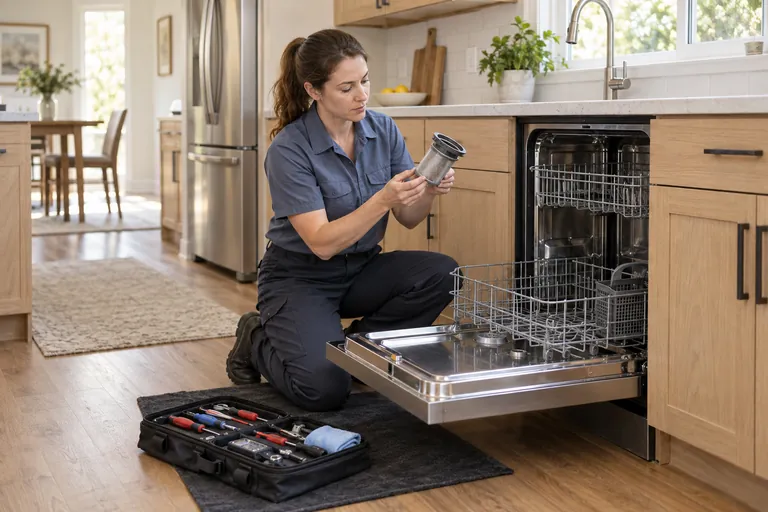
Most modern dishwashers — Bosch, Miele, KitchenAid, Samsung, and LG — use a manual-clean cylindrical filter at the base of the wash tub. Edmonton's hard water means mineral-encrusted food debris can completely block this filter within 2–4 months in homes that skip regular maintenance. Remove the lower rack, twist out the cylindrical filter, and rinse it under warm running water. Scrub with a soft brush and white vinegar to dissolve mineral deposits. This simple step resolves roughly 35–40% of all dishwasher not-draining calls without any parts or professional service required.
2. Check the Drain Hose High Loop
The drain hose must loop up to the underside of the countertop before dropping down to the sink drain or garbage disposal connection. Without this high loop, water from the sink drain siphons back into the dishwasher tub. If your dishwasher was recently installed or had any cabinet work done beneath it, verify the drain hose routing. The hose should be secured at counter height with a clamp or hose clamp. This is a zero-cost fix if caught early.
3. Check the Garbage Disposal Knockout Plug
If your dishwasher drains through a garbage disposal connection and you recently installed a new disposal, the factory knockout plug inside the disposal's dishwasher inlet port may still be in place. This plastic plug must be removed before connecting the dishwasher drain hose, or water will have nowhere to go. This is an easy fix but is often missed during new disposal installations in Edmonton kitchen renovations.
4. Inspect the Drain Hose for Kinks or Blockages
The corrugated plastic drain hose can kink if the dishwasher was pushed back too aggressively after installation or if a heavy object was placed on it. Pull the dishwasher forward slightly and inspect the full hose run. A kinked hose is easy to straighten but may need replacement if it has been kinked repeatedly and the corrugation has cracked.
5. Test the Drain Pump
If all the above checks pass, the drain pump itself may be seized or burned out. The drain pump runs briefly at the end of each cycle to expel water from the tub. A failed pump produces a humming sound during the drain phase without actually moving water, or produces no sound at all. On Bosch dishwashers (very common in Glenora and Westmount Heritage Area homes), error code E24 specifically flags a drain pump fault. Drain pump replacement: $120–$200 depending on brand and model.
6. Check the Check Valve / Drain Solenoid
Some older dishwashers use a drain solenoid or a check valve flap to control water flow direction. A stuck or failed check valve allows water to flow back into the tub after the drain cycle completes, leaving a small amount of standing water. A check valve replacement is a $60–$100 repair and is often overlooked because the dishwasher appears to drain but has residual water at the bottom after the cycle.
Edmonton Dishwasher Not Draining Repair Costs
| Cause | DIY or Pro? | Estimated Cost |
|---|---|---|
| Clogged filter | DIY | Free |
| Missing high loop on drain hose | DIY | Free |
| Garbage disposal knockout plug | DIY | Free |
| Kinked or blocked drain hose | Pro recommended | $60–$100 |
| Drain pump replacement | Pro | $120–$200 |
| Check valve / solenoid | Pro | $60–$100 |
| Control board (drain cycle fault) | Pro | $150–$280 |
Alberta Hard Water and Your Dishwasher
Edmonton's water hardness accelerates mineral buildup in the dishwasher's spray arms, filter, and pump housing. Hard water deposits reduce drain pump efficiency over time by narrowing the impeller clearances, eventually causing the pump to seize under partial blockage conditions. Running your dishwasher with a monthly dose of citric acid or a commercial dishwasher cleaner (such as Affresh) dissolves mineral buildup before it reaches critical levels. Using a rinse aid in every wash cycle also significantly reduces spotting and helps water sheet off surfaces rather than pool in the filter area.
Homes in Sherwood Park and Beaumont, served by Strathcona County water, often see slightly higher mineral content than core Edmonton neighbourhoods. If you notice cloudy glassware and frequent dishwasher drain issues, a whole-house water softener is a worthwhile long-term investment that protects all water-using appliances simultaneously.
Dishwasher Not Draining? Book Edmonton Repair Online
On-site appointments in Edmonton, Sherwood Park, St. Albert, Spruce Grove, Leduc, and Fort Saskatchewan. No phone required — book or email us.