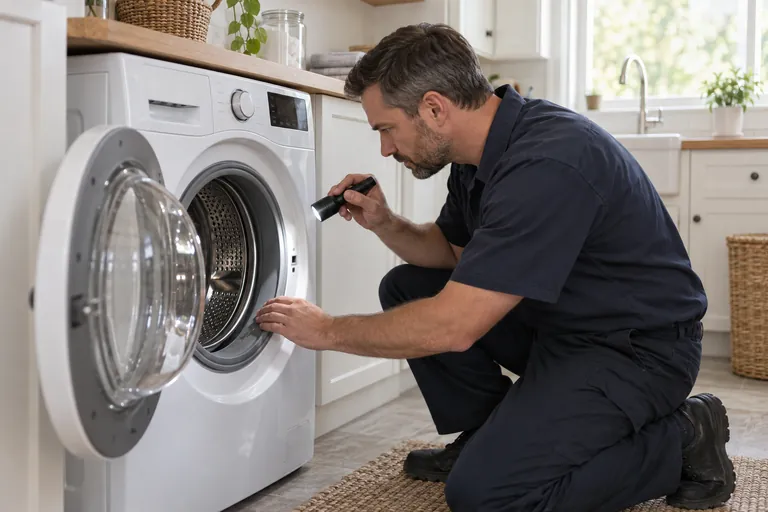
Fixlify Appliance Services diagnoses microwave no-heat failures across Toronto using high-voltage circuit testing that identifies whether the fault is the magnetron, high-voltage diode, capacitor, or transformer — before recommending any part or replacement. When your microwave runs but doesn't heat, our technician David K. performs a complete high-voltage circuit evaluation and delivers a digital repair-vs-replace recommendation. Call (437) 524-1053 for professional microwave diagnosis in Toronto.
TL;DR: Microwave runs but doesn't heat = fault in the high-voltage circuit (magnetron, diode, capacitor, or transformer). Magnetron filament resistance test: 2–3 ohms = good, open circuit = failed. Repair worthwhile for OTR/built-in units ($200–$320 CAD). Countertop units under $200 new: replacement usually more economical. Never open a microwave without discharging the capacitor — it holds lethal charge even when unplugged.
How the Microwave High-Voltage Circuit Works
A microwave oven generates heat by converting household 120V AC into microwave radiation at 2.45 GHz. The high-voltage circuit that powers the magnetron has four series components:
- High-voltage transformer — steps household voltage up to approximately 2,100V AC secondary output. Also has a low-voltage secondary winding powering the magnetron filament.
- High-voltage capacitor — stores energy and, combined with the diode, acts as a voltage doubler, producing approximately 4,000V DC to the magnetron anode.
- High-voltage diode — rectifies the AC from the capacitor into pulsed DC. When the diode fails, it can short or open, disabling the magnetron or causing an arcing condition.
- Magnetron — the vacuum tube that converts the high-voltage DC into microwave radiation. Contains a filament (cathode) heated by the transformer's low-voltage winding, which emits electrons accelerated by the anode voltage to produce microwaves.
Any failure in this series circuit stops heating. The diagnostic challenge is determining which of the four components has failed — they all produce the same visible symptom: the microwave operates normally but food stays cold.
Magnetron vs. Diode vs. Capacitor — How Technicians Distinguish Them
Our diagnostic sequence tests from safest-to-test to most dangerous-to-test, and from cheapest-failed-part to most-expensive:
Capacitor Discharge — Mandatory First Step
Before any internal testing, the high-voltage capacitor is safely discharged using a high-wattage resistor across its terminals. The capacitor stores approximately 2,100V at dangerous current levels. This discharge procedure is mandatory regardless of how long the microwave has been unplugged — capacitors can hold charge for hours or days.
High-Voltage Diode Test
The diode is tested with a multimeter's diode mode. A good diode shows low resistance in one direction and high resistance in the other. A shorted diode reads low resistance in both directions. A failed diode is the lowest-cost repair ($20–$40) and is tested first.
Magnetron Filament Resistance Test
Magnetron filament resistance measured between the two filament terminals. Normal range: 2–3 ohms. An open circuit (infinite resistance) confirms the filament is broken and the magnetron has failed. This is the most common cause of no-heat — found in approximately 60% of microwave no-heat diagnoses.
Capacitor and Transformer Testing
Capacitor capacitance measured with a capacitance meter — should read within 10% of rated value (typically 0.9–1.1 µF). Transformer primary and secondary winding resistance checked for open circuits. Transformer failures are the most expensive repair and the least common cause of no-heat.
Microwave repair is not a DIY appliance task. The high-voltage capacitor in a microwave oven stores enough electrical energy to be lethal — equivalent to several cardiac defibrillation shocks. This capacitor retains its charge even after the microwave is unplugged. Any internal microwave work must begin with a proper capacitor discharge procedure using a correctly rated resistor. Fixlify technicians are trained in this procedure. Do not open a microwave cabinet without this training.
Repair vs. Replace: The Microwave Decision
Unlike refrigerators and washers, microwave repair economics depend heavily on the appliance type:
- Countertop microwaves (new cost under $200 CAD): Magnetron replacement at $200+ repairs a machine worth less than the repair. Replacement is almost always more economical.
- Over-the-range (OTR) microwaves (new cost $400–$800 CAD): A $220–$320 CAD magnetron replacement extends the appliance life by 5–8 years and represents 30–50% of replacement cost — generally worth repairing for machines under 8 years old.
- Built-in and combination microwave-convection ovens (new cost $700–$1,500 CAD): Repair at $250–$400 CAD is almost always economical for machines under 10 years old.
Fixlify provides a digital repair-vs-replace recommendation in every magnetron diagnostic report, with the current replacement cost of your specific model included for comparison.
Microwave Magnetron Repair Costs in Toronto — 2026
- High-voltage diode replacement: $85–$120 CAD (parts + labour)
- Magnetron replacement (OTR or built-in): $200–$320 CAD
- High-voltage capacitor replacement: $100–$160 CAD
- High-voltage transformer replacement: $220–$350 CAD
- Premium brands (Bosch, Miele magnetron): $280–$400 CAD
Fixlify has serviced over-the-range and built-in microwaves in Toronto since 2017, specializing in GE, LG, Samsung, Whirlpool, and Bosch models. Every microwave repair is performed with proper high-voltage safety protocols and documented with a digital work order and receipt. A 90-day labour warranty is included with every repair.
Microwave Not Heating in Toronto?
Our technicians safely test the complete high-voltage circuit to identify the exact failed component — diode, magnetron, capacitor, or transformer. Digital quote before any part is ordered.
Book Microwave Repair