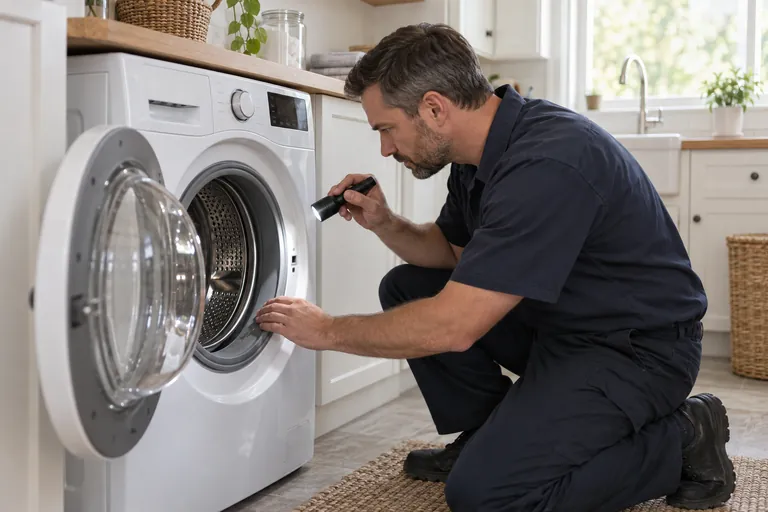
Your washing machine just stopped working mid-cycle, and now you're faced with the classic homeowner dilemma: call a technician or head to the appliance store? This question comes up dozens of times a week in our service calls across Toronto and the GTA. Here's how to think through it clearly, with real numbers and a structured framework that actually helps you decide.
The 50% Rule — And Why It Needs Context
The appliance industry's standard guidance is the "50% rule": if a repair costs more than 50% of what a new equivalent washer would cost, replace it. It's a useful starting point, but it ignores two important variables: the washer's age and its remaining useful life.
A 3-year-old front-loader that cost $1,100 new has roughly 8–10 years of life ahead of it. Spending $350 on a pump or bearing repair (32% of replacement cost) is clearly worthwhile. That same $350 repair on a 12-year-old machine with perhaps 2 years of life left is a different story — you'd be spending $350 to recover maybe 2 years of use, at which point you'll be buying a new washer anyway.
Lean Toward Repair When...
- Washer is under 8 years old
- Repair cost is under 40% of replacement value
- Problem is a single component failure
- No recurring issues in the last year
- Premium brand with known longevity
- Condo/unit where delivery is complicated
Lean Toward Replace When...
- Washer is 10+ years old
- Repair cost exceeds 60% of replacement
- Multiple components failing (bearing + drum + seal)
- Second repair within 12 months
- Budget-tier brand with limited parts availability
- Energy costs are significantly higher than ENERGY STAR ratings
Repair Cost Scenarios in Toronto (2026)
| Problem | Repair Cost | Washer Age | Verdict |
|---|---|---|---|
| Lid switch / door latch | $120–$180 | Any | Repair |
| Water inlet valve | $130–$200 | Any | Repair |
| Pump replacement | $150–$250 | Under 9 yr | Repair |
| Door seal (front-load) | $180–$280 | Under 8 yr | Repair |
| Motor control board | $220–$380 | Under 7 yr | Assess |
| Drum bearing replacement | $280–$450 | Under 6 yr | Assess |
| Outer tub replacement | $320–$550 | Under 5 yr | Assess |
| Transmission | $350–$500 | Under 4 yr | Consider Replace |
| Control board + pump combo | $350–$600 | Over 8 yr | Replace |
Energy Savings: New vs. Repaired
A new ENERGY STAR front-loading washer uses roughly 12–14 litres of water per cycle versus 130+ litres for a top-loading agitator washer from 15 years ago. Over 300 cycles per year, that's a meaningful reduction in water and heating costs. Ontario's electricity rates make this even more relevant — hot water heating is a real operating cost.
For a 12-year-old, pre-ENERGY STAR top-loader, the annual operating savings from upgrading to a modern front-loader can be $80–$120 in utility costs. Over 10 years, that's $800–$1,200 in savings — enough to justify replacement even if the repair itself would be relatively inexpensive.
The environmental case for repair: Manufacturing a new washing machine produces approximately 200–300 kg of CO2. Repairing your existing one produces a fraction of that. For Torontonians with sustainability goals, a $200 repair extends the machine's life by 3–5 years and avoids significant manufacturing emissions. Toronto's landfill constraints also make proper appliance disposal a real consideration.
The Age Factor: Washer Life Expectancy
Most major-brand washing machines last 10–14 years in average Toronto households. Front-loaders, with more complex bearings and seals, typically last 11–13 years before major component failures become common. Top-loaders with simpler direct-drive mechanisms can reach 14–15 years.
Our service data shows that washers aged 8–10 years start seeing multi-component failures — not because all parts fail simultaneously, but because the same environmental stress (water, detergent, vibration) affects everything on the same timeline. A washer that needs a bearing at year 9 may need a pump at year 10 and a control board at year 11.
Practical Decision Framework
- Get a diagnostic quote first — don't guess the problem.
- Check the washer's age and look up the cost of an equivalent replacement.
- Apply the 50% rule, but weight it against remaining life expectancy.
- Ask the technician: "Is this a single failure or are there other components showing wear?"
- Factor in energy savings if upgrading to ENERGY STAR-rated equipment.
On-site service is available by appointment; submit a booking request so the team can confirm current availability.
Get a Straight-Talking Diagnostic
We'll tell you what the repair costs and whether it's worth it. No pressure, no upselling.